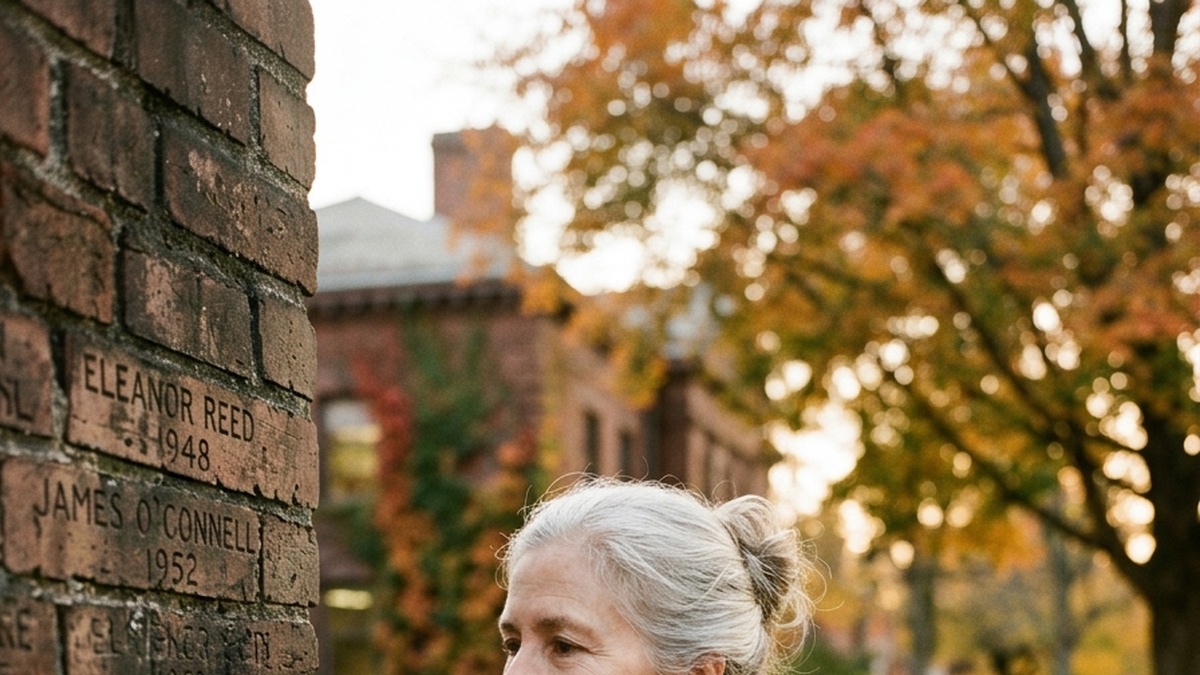
Michael Tran had driven all the way from Dayton to ask for one name on a brick wall, and Carl Ebersole told him no before he finished asking.
Carl said it from the long table by the window, without looking up from his binder. He was seventy-four and had run the night shift at Calder Glass Works for nineteen years. When the committee needed someone to keep the list of names, his was the only hand that went up.
Ruth Ann Mercer set down the book she had been mending. She volunteered at the Carnegie library on Wednesdays. In thirty-eight years of teaching third grade, she had learned that the quietest voice in a room usually had the most to say. The man at the desk had a very quiet voice.
"I'm sorry," she said. "I didn't catch your name."
"Michael Tran. I'm a pharmacist in Dayton." He was about fifty, neat, in a good wool coat. "My father was Minh Tran. He worked nights at the glass works from 1980 until it closed. He passed away in April."
"I'm sorry for your loss," Ruth Ann said.
"Thank you." He turned toward Carl. "I read in the paper that you're adding a plaque this month. For names that got missed."
That was true. Out on the library lawn, the six brick panels of the Name Wall held about a thousand names under the roof Walt Brenner had built. Since then, families had written in about fathers and uncles who had been left off. The committee had agreed on one small bronze plaque. The list went to the engraver in Marietta on Thursday at noon.
"I've got eleven names on that plaque," Carl said. "Every one of them, I could tell you what shift they worked and what they drove to work. There was never a Tran on my floor."
"He worked in the batch house," Michael said. "Nights. He mixed the sand."
"I ran the batch house at night. I'd remember."
Ruth Ann made coffee in the little back room and brought out three cups. She had found that people argued less with a cup in their hands.
Michael told it simply. His parents had come from a refugee camp in Malaysia in the spring of 1980, with him wrapped in a blanket at two years old. A church in Ohio had sponsored them. That was how they ended up in a town they had never heard of, in the hills, in a rented half of a house on Maple Street.
"Grace Methodist," Ruth Ann said. "I remember the potluck when your family came. Somebody made a ham. Your mother was so polite about it."
Michael smiled for the first time. "She never did eat ham."
His father had found work at the glass works that first summer. When it closed in 1986, the family stayed one more school year, then moved to Dayton, where an uncle had found him work at a tool and die shop.
"Do you have anything from the glass works?" Carl asked. "Pay stubs. A badge. A lunch pail."
"No." Michael looked at his cup. "My father didn't keep things. He said if you look back too long at a camp, you never leave it. He only talked about this town at the very end. He said they put the names on a wall. He said his was there."
Carl closed the binder on his thumb. He was not a hard man. Ruth Ann had known him since he was a skinny boy who carried groceries at the IGA. But two years ago, a prankster had sent in a cartoon name, and it had gotten all the way onto a brick before anyone caught it. The Ledger ran a photo. Carl had stood on the lawn while a man from Marietta ground it off.
He had not forgotten how that felt.
"I'm sorry," Carl said. "I truly am. But I can't put a name on that wall just because somebody says so."
Ruth Ann studied Michael while the two men talked. She had a habit her friends found odd. She remembered every student's middle name. All thirty-eight years of them. She could stand in the produce aisle in Athens and say, "Hello, Dennis Lee," to a gray-haired man who had not heard his middle name since his mother passed.
She was sure she had never had a Michael Tran.
"Did you go to school here?" she asked.
"Pine Hollow Elementary. Kindergarten through third grade."
"Do you remember your third-grade teacher?"
Michael thought. "A lady who pressed flowers in the dictionary. She let me keep a leaf once."
Ruth Ann felt the back of her neck go warm. She pressed flowers in old books. She had done it in every classroom she ever had.
She began, quietly, to go through the class of 1986. Wade Allen Sutter by the pencil sharpener, who she held back that year and who had since written two books. Tammy Jo Pike. Darrell Wayne Combs. She went down the rows in her mind the way she used to take attendance.
There was no Michael. Not in that room, or the year before, or the year after.
Michael was standing now, buttoning his coat. He was staying at a motel in Marietta through Thursday, he said, though he did not see much point in it now. "Thank you for the coffee." He set a business card on the desk. "If anything comes to mind."
Ruth Ann walked him out to the lawn.
The wind came down Elm Street hard enough to rattle the roof Walt had built. Michael walked the length of the six panels slowly, reading. He stopped at the fourth one and put his hand flat on the cold brick.
"He said he was here," he said. "I guess I wanted it to be true more than it was."
He got into his car. Ruth Ann watched the taillights turn onto Main and go out of sight past the stoplight.
She stood by the wall a long time with her coat pulled tight. Somewhere in the back of her head, a child's voice was saying something from a long time ago. She could hear the classroom radiator knocking and smell the paste. She could not quite hear the words.
Through the library window, she could see Carl at the long table with the phone to his ear, reading eleven names to the engraver, one at a time.