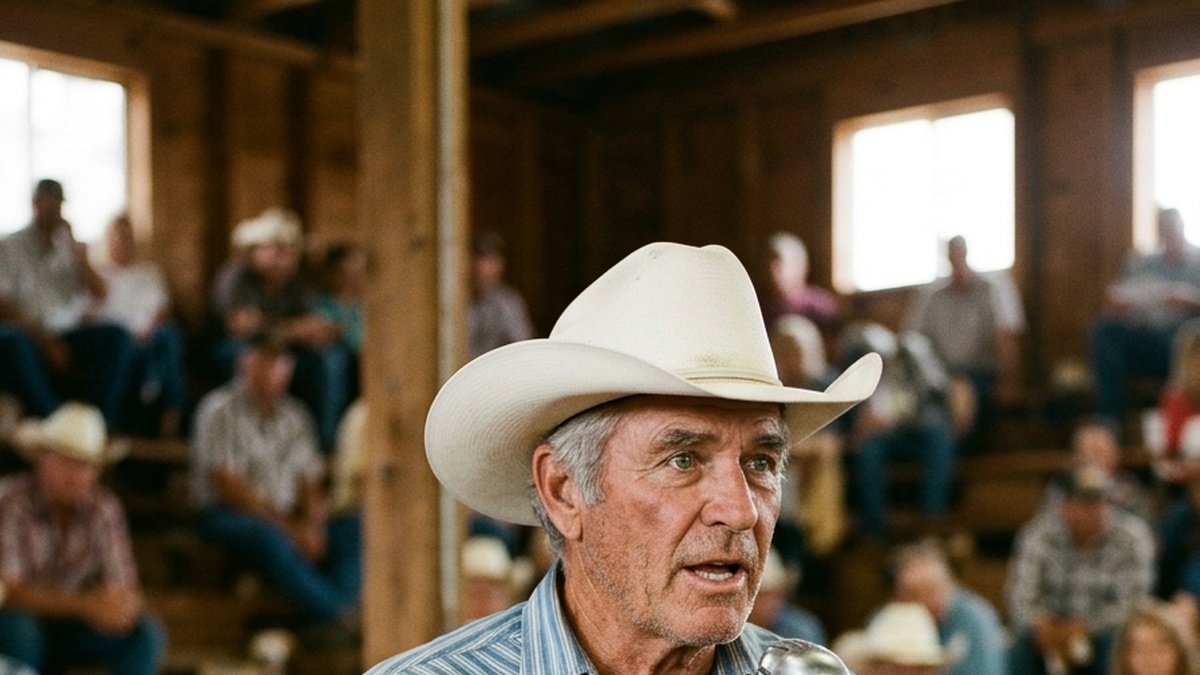
By the third lot of the morning, Ray Dunbar knew that two men in matching tan jackets were robbing Darlene Pike, and they were doing it right in front of his auctioneer's stand.
He did not stop the chant. Seventy years old, and he could still roll the numbers off his tongue faster than most men could think them. But his eyes went to the third row, left side, where the two buyers sat a seat apart.
They had not bid against each other once.
Darlene Pike had driven down from Columbus on Friday with her late cousin's sale papers in a manila folder. Her cousin Russell had run twenty-two Angus cows on the old Pike ground on Hollow Creek Road until his heart gave out in October. Russell had no children. Everything went to his mother, Ada Pike, who was ninety-one and living at Maple Grove.
Darlene was fifty-eight and worked in an insurance office. She did not know a heifer from a hay bale. She knew that Ada's room at Maple Grove cost more every month than Darlene made, and that the cows were the only thing of value Russell had left.
"Just get what's fair," she had told Ray in the office that morning, holding her coffee with both hands. "That's all I'm asking. Whatever's fair."
Ray had promised her he would.
Bev Truitt had worked in the sale barn office for thirty-one years. Between the second and third lots, she slipped a note onto Ray's stand.
Gaskins and Fenn came in together. Same truck. Parked out back.
Ray glanced at it and kept chanting.
Merle Gaskins was a cattle dealer from two counties west, about sixty, with a heavy gold ring and a smile that never went past his teeth. Rudy Fenn was younger, maybe thirty-five, and quiet. They had been coming to Calder County sales off and on for a year. Ray had never paid them much mind.
He paid them mind now.
The Pike cows were good cows. Young, sound, black, well fed. The first lot should have brought a strong price. Gaskins opened low. Fenn sat still. A farmer from Zanesville bid once, then dropped out when Gaskins came back over him. Fenn never moved.
Then the second lot. Fenn opened low. Gaskins sat still. Same farmer bid once, dropped out.
Then the third. Gaskins again. Low.
They were taking turns.
Ray knew what it was. He had seen it twice in forty years. Two buyers agree ahead of time not to bid against each other. They split the lots between them and keep the price down. Afterward, they settle up in the truck. It was called a ring, and it was against the law, and it was nearly impossible to prove from the auctioneer's stand.
He looked at the back row.
Clay Hollister sat where he always sat, in the top seat by the door, with his hat tipped forward. Clay read cattle and people by the way they moved. Ray caught his eye.
Clay touched the brim of his hat and tipped his head, very slightly, toward Merle Gaskins.
Ray followed it. Every time the bidding came near the end of a lot, Gaskins reached up and touched his left earlobe. When he did, Fenn sat still. When he didn't, Fenn bid.
Ray kept chanting. But his face had gone hot.
Lot four came into the ring. Six young cows, the best of Russell's herd. They should have brought more than the first three lots put together.
Gaskins touched his ear.
Fenn opened. Low. The farmer from Zanesville bid once. Fenn came back over him. The farmer shook his head.
Ray looked at the number on his board. It was not much more than half what those cows were worth.
He looked at Darlene Pike, sitting alone in the front row with her manila folder in her lap. She was smiling hopefully at the ring. She had no idea.
Ray's job was to sell cattle. The barn's job was to keep buyers coming back. And a man who stopped a sale in the middle of a lot, with no proof, could lose the trust of every buyer in that room.
He raised his gavel.
Then he set it down again on the stand, very gently.
"No sale," Ray said.
The barn went quiet. A cow in the ring shifted her feet on the sawdust.
Merle Gaskins stood up slowly.
"What do you mean, no sale?"
"I mean those cows didn't bring what they're worth," Ray said into his microphone. "And I don't believe they're going to today. So we're going to pass this lot and take a break."
"You can't just pass a lot because you don't like the price."
"I can if the seller hasn't agreed to it," Ray said. "And she hasn't."
Gaskins looked around the bleachers. Then he raised his voice so the whole barn could hear.
"I've bought cattle at this barn for a year, Dunbar. So has Rudy. So have half the men we buy for." He gestured at the bleachers, where a dozen buyers were watching. "You start stopping sales because you've got a feeling, and we'll take our business to Zanesville. All of it. And so will they."
Several of the buyers looked at their boots.
Ray stood behind his stand with the microphone gone heavy in his hand, and for the first time in forty years of selling cattle, he could not think of a single word.